Garage door control

Application Guide

Garage door control with Shelly

Open and close your garage door from anywhere with reliable Shelly relays and door sensors.

Last updated: April 2026

Introduction

A Shelly relay turns almost any existing garage door opener into a remotely controllable door. By wiring the relay in parallel with the existing wall button and triggering a short pulse, you can open or close the door from the Shelly Smart Control app, a schedule, or an automation — without modifying the motor itself.

This guide covers the recommended hardware, wiring principle, the critical Auto-Off Timer setting, and how to add an optional door sensor for real open/closed status in the app.

Quick start — find your scenario

Compatibility table

Pick the relay and sensor combination that matches the level of feedback you want in the app.

Component Recommended device Power supply Function Notes
Relay (recommended) Shelly 1 Gen4 12 V DC, 24–48 V DC, or 110–240 V AC Triggers garage door opener Supports Shelly Plus Add-On for sensor input
Wired sensor Shelly Plus Add-On + reed switch Powered by Shelly 1 Detects open/closed Enables “Garage Door” mode in the app
Wireless sensor Shelly BLU Door/Window Battery (CR2032) Detects open/closed via Bluetooth No extra wiring; status only (no Garage Door mode)
Alternative relays Shelly Plus Uni, Shelly 1 Mini Gen4, Shelly Pro 1 Various Trigger only No support for Plus Add-On with reed switch

Installation

Six steps from device choice to verified operation. Follow them in order — Step 4 (Auto-Off Timer) is the one that most installations get wrong.

Choose your relay

When to use this approach: we recommend the Shelly 1 Gen4 for garage door control because it supports the Shelly Plus Add-On, which lets you connect a reed switch to monitor open/closed status. The Shelly Plus Uni, Shelly 1 Mini Gen4, and Shelly Pro 1 work as alternatives if status monitoring isn’t needed.

The Shelly 1 Gen4 supports:

  • 12 V DC
  • 24–48 V DC
  • 110–240 V AC

This makes it compatible with virtually all garage door opener systems.

Wire the relay

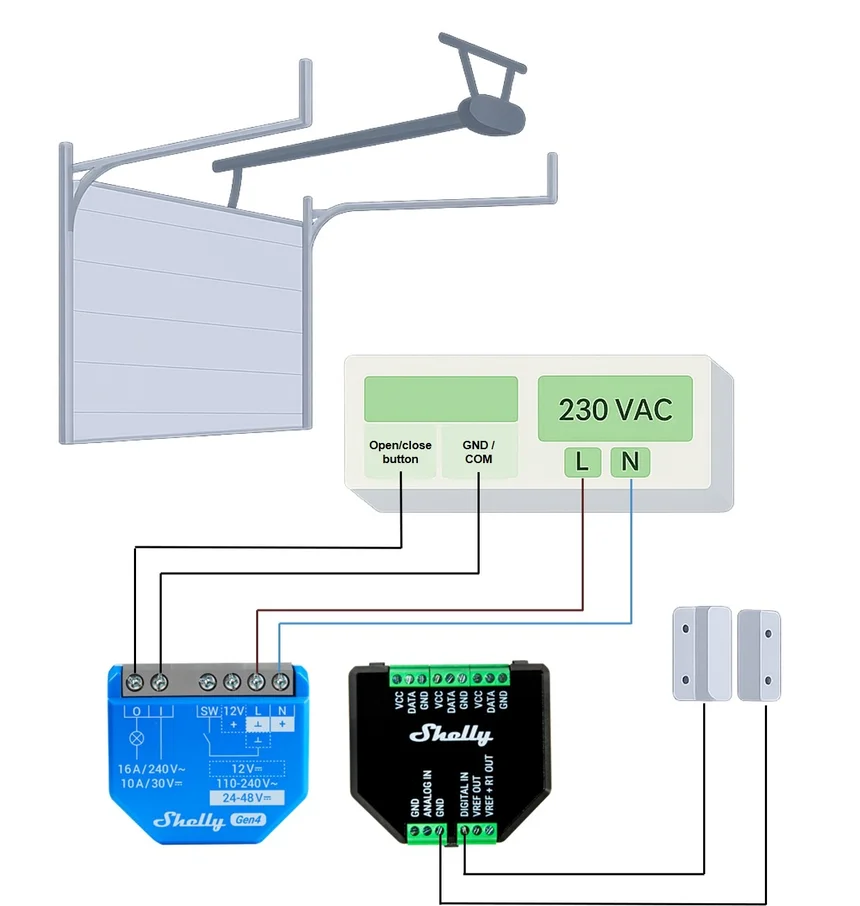
Wire the Shelly 1 Gen4 according to the diagram. The example shows 230 V AC supply, but the principle is identical for 12 V or 24 V DC — only the supply terminals change.

The relay’s potential-free output (terminals O and I) connects in parallel with the existing wall button on the garage door opener. This means the wall button and Shelly both work — neither replaces the other.

L
Line in (or 12/24–48 V DC +)
N
Neutral (or DC return)
O
Potential-free output — to opener trigger
I
Potential-free common — to opener trigger
Wiring diagram showing a Shelly 1 Gen4 relay connected in parallel with the existing wall button on a garage door opener.
Shelly 1 Gen4 wired in parallel with the existing wall button. The motor’s main supply is left untouched.

Add a sensor (optional but recommended)

You can use the Shelly 1 Gen4 without a sensor, but adding a door/window sensor lets the app show the actual open/closed status of the door — much more useful than just “I clicked the button”.

Two options:

Wired (recommended): Shelly Plus Add-On + reed switch

  • Connect a magnetic reed switch to the Shelly Plus Add-On
  • The Add-On plugs into the Shelly 1 Gen4
  • Mount the reed switch on the door frame, magnet on the door itself
  • Configurable as “Garage Door” type in the app, showing the proper icon

Wireless: Shelly BLU Door/Window

  • Battery-powered (CR2032), no wiring required
  • Connects via Bluetooth to a Shelly gateway device
  • Shows open/closed status, but cannot be linked to the Shelly 1 as a “Garage Door Controller” (no garage door icon in the app)

Set the Auto-Off Timer (critical)

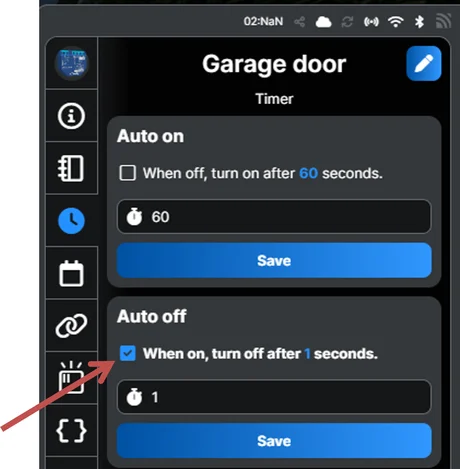
Garage door openers expect a momentary pulse (like pressing a wall button). Without an Auto-Off Timer, the relay stays closed and the opener will not work correctly — and you risk damaging the motor.

Configure as follows:

  1. Open your Shelly 1 Gen4 in the Shelly Smart Control app
  2. Go to Timer settings
  3. Enable Auto-Off
  4. Set duration to 1 second
Shelly Smart Control app showing the Auto-Off Timer enabled and set to 1 second.
Auto-Off Timer set to 1 second — the relay closes briefly, then opens again, mimicking a wall button press.

Configure the sensor in the app

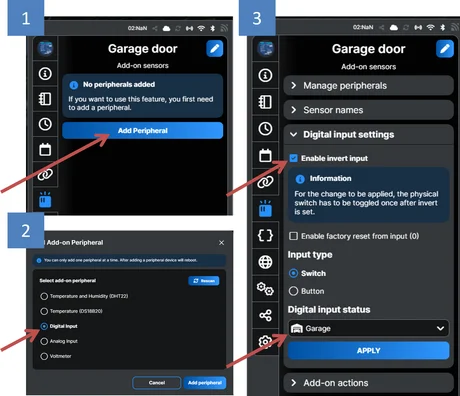
If you have added the Shelly Plus Add-On with a reed switch, configure it as a Garage Door sensor:

  1. Open Shelly 1 Gen4 in the app
  2. Tap Add peripheral → select Digital input
  3. After the device reboots, open Peripheral settings
  4. Enable Invert input
  5. Set Digital input type to Garage
Peripheral settings screen with Invert input enabled and Digital input type set to Garage.
Peripheral settings: invert the input and set the type to Garage.

Test and verify

Test from the app:

  • Tap the garage door icon → relay should pulse for 1 second
  • The opener should activate (door opens or closes)
  • The sensor should reflect the actual door state in the app
Shelly Smart Control dashboard showing the garage door tile with current open/closed status.
Garage door tile on the dashboard, showing live status from the reed switch.

Video tutorial

A step-by-step video walkthrough is coming soon.

By ShellyGuide on YouTube

Tips & best practices

  • Always wire in parallel with the existing wall button — never interrupt the motor’s main supply.
  • If the door doesn’t react, verify the Auto-Off Timer is set to 1 second and that you wired to the potential-free output (O/I), not the line output.
  • If the sensor shows the wrong status (open/closed reversed): toggle the “Invert input” setting in the app.
  • Use schedules for door-left-open warnings. Trigger a notification when the door has been open for more than 10 minutes.
  • Combine with Shelly BLU Motion in the garage to automate lights when you arrive.
  • Share access without sharing accounts. Use the Shelly Smart Control app’s user permissions to give family members access to the door only.